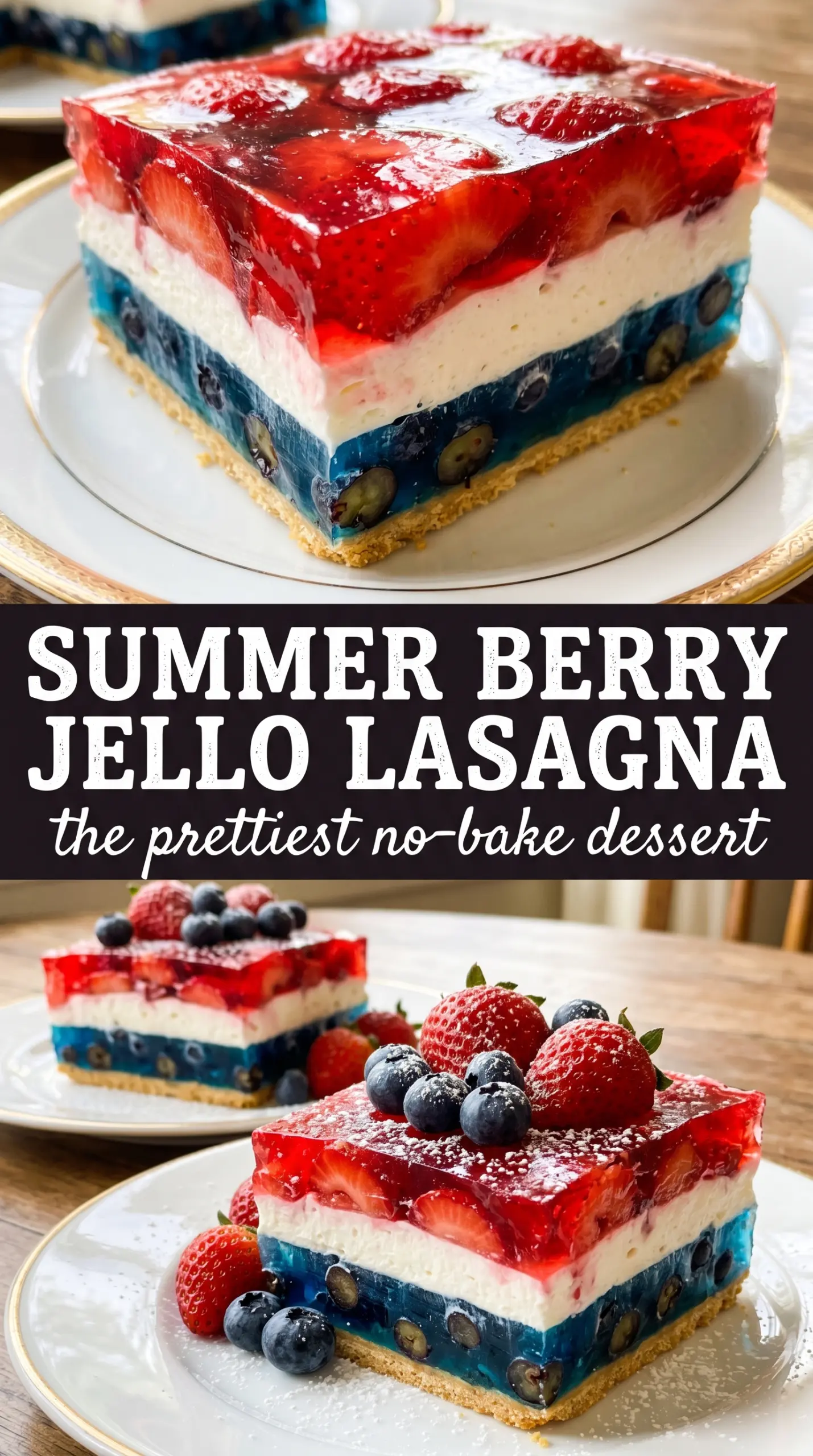
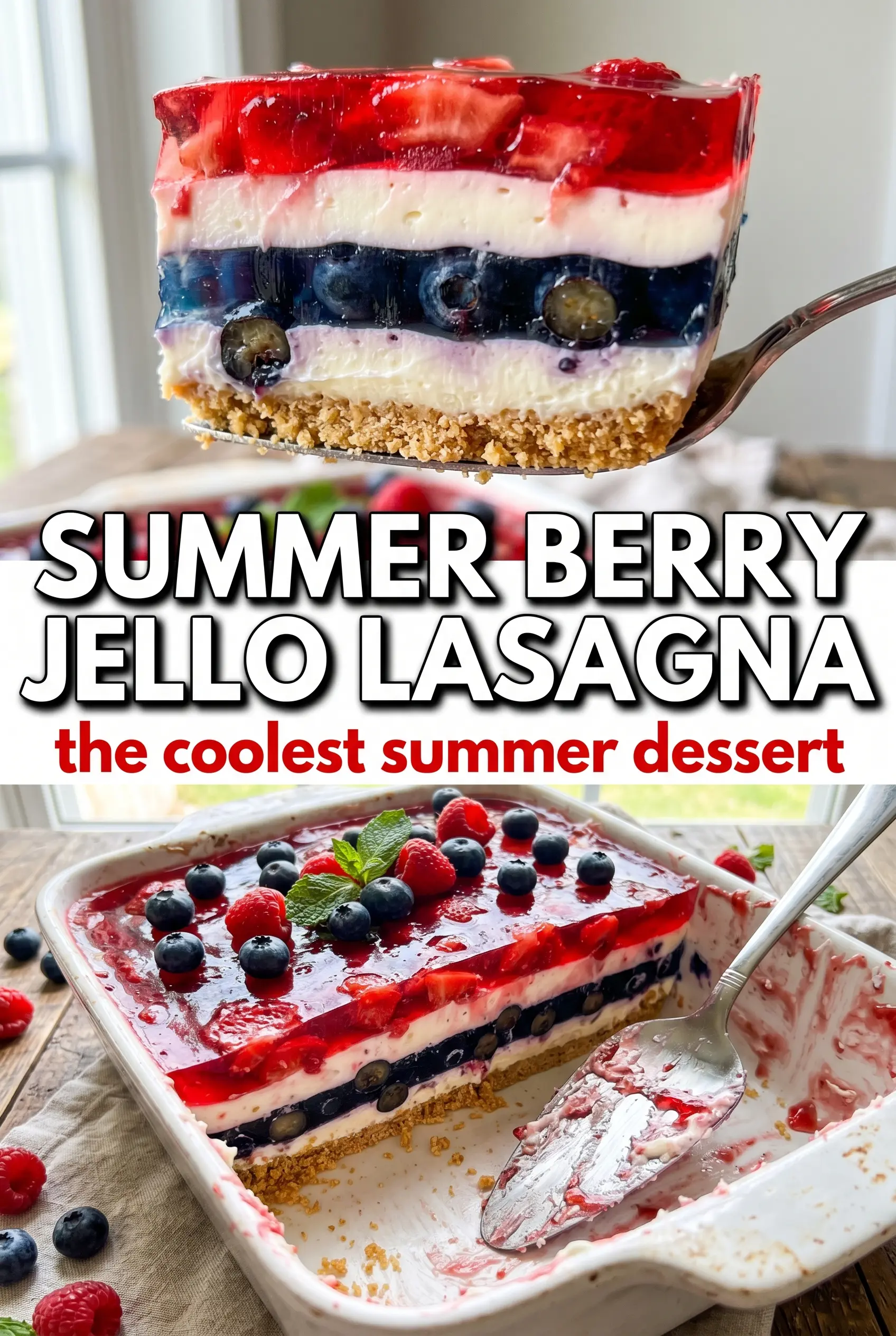
Summer Berry Jello Lasagna slices cleanly into bright, distinct layers that look as good as they taste: buttery Golden Oreo crust, a smooth cream cheese middle, and two jewel-toned Jell-O layers that hold their shape. The first bite is cold, creamy, and just sweet enough, with the strawberry and blueberry layers keeping it from feeling heavy.
What makes this version work is patience between layers. The Jell-O needs to cool to room temperature before it goes anywhere near the cream cheese, or the heat will melt the filling and blur the lines. The cream layer also stays sturdier when the whipped topping is folded in gently instead of beaten hard, which keeps it light without turning loose.
Below, I’ve included the timing that keeps the layers separate, the ingredient swaps that still give you a neat slice, and the small tricks that help this dessert come out tall, chilled, and party-ready.
The layers set up beautifully, and the strawberry Jell-O stayed separate from the blueberry instead of bleeding together. I chilled it overnight, and every slice came out clean with that soft creamy middle.
Like this strawberry-blueberry Jell-O lasagna? Save it to Pinterest for a no-bake dessert with clean layers and a buttery Golden Oreo crust.
The Layer Timing That Keeps the Jell-O from Bleeding
The biggest mistake in a layered Jell-O dessert is rushing the chill time between pours. If the strawberry layer hasn’t fully set before the blueberry layer goes on, the colors will drift into each other and the clean stripe effect disappears. This dessert needs the kind of patience that lets each layer carry its own weight.
The cream cheese layer matters here too. It acts like a barrier between the crust and the Jell-O, but only if it’s spread evenly and chilled before the first pour. If it’s lumpy or soft in spots, the Jell-O can sink in unevenly and leave you with a slanted slice instead of neat layers.
- Golden Oreos — These give the crust a vanilla-cookie flavor that fits the berry layers better than a chocolate crust would. Crush them fine enough that they pack tightly; bigger crumbs make the base crumble when you slice.
- Cream cheese — Full-fat cream cheese gives the middle layer enough body to stand up to the Jell-O. Softened cream cheese is nonnegotiable here, or you’ll end up chasing lumps no matter how long you beat it.
- Whipped topping — This keeps the filling light and sliceable. If you swap in homemade whipped cream, use a stabilized version, because plain whipped cream can loosen the layer as it sits.
- Berry Jell-O flavors — Strawberry and berry blue give the dessert its clear red, white, and blue contrast. The boxed mix is one place where the standard version works best; it sets predictably and gives you the sharpest layers.
What Each Ingredient Is Actually Doing in This Recipe
- Primary ingredient (the star) — Quality matters most. Choose the best you can find.
- Cooking medium (oil, butter, or broth) — This carries flavors and prevents dryness.
- Seasonings (salt, pepper, spices, herbs) — Layer flavors so nothing overpowers. Build depth gradually.
- Aromatics (garlic, onion, herbs) — Cook with fat to bloom flavors. Become the foundation.
- Supporting ingredients — Complement the main ingredient without overpowering it.
- Sauce or liquid (if applicable) — Brings flavors together. Balance richness with acid.
- Acid (lemon, vinegar, wine, or other) — Brightens and prevents flat-tasting results.
- Final finish (garnish, glaze, or sauce) — Prevents one-dimensional taste and adds visual appeal.
Building the Dessert in Layers Without Disturbing the Base
Pressing the Crust Firmly
Mix the crushed Golden Oreos with melted butter until every crumb looks damp, then press it hard into the bottom of a 9×13 dish. A flat-bottomed measuring cup helps get an even layer without loose pockets. Chill it for 20 minutes so it firms up before the cream filling goes on; if the crust is still soft, the middle layer can drag crumbs through it.
Whipping the Cream Layer Smooth
Beat the softened cream cheese with powdered sugar until it’s completely smooth before folding in half the whipped topping. Stop as soon as the mixture looks uniform and fluffy. Overmixing with the whipped topping can thin it out, and a loose filling won’t support the Jell-O layer the way it should.
Cooling the Jell-O to the Right Point
Dissolve each Jell-O powder fully in boiling water, then stir in the cold water and let it cool to room temperature. It should be cool to the touch but still liquid. If it starts to thicken even a little, stop and whisk it back smooth before pouring; partially set Jell-O creates streaks and clumps instead of clean layers.
Pouring and Chilling Each Color
Pour the cooled strawberry layer slowly over the cream filling, using the back of a spoon if needed to soften the flow. Chill it until fully set before adding the blueberry layer, then repeat the same gentle pour. Rushing this part is how the layers blend together, and once they do, there’s no fixing the clean look.
Finishing for Clean Slices
Spread the remaining whipped topping over the top and chill the whole dish again before slicing. A sharp knife wiped clean between cuts gives the neatest rectangles. If you serve it too early, the top layer smears and the whole dessert loses that tall, tidy look.
How to Change the Layers Without Losing the Shape
Make it gluten-free with a cookie crust that still holds
Use certified gluten-free vanilla sandwich cookies in place of the Golden Oreos. The crust still needs to be crushed finely and packed tightly, because the structure comes from the crumbs and butter, not the cookie brand. The flavor stays in the same sweet-vanilla lane.
Swap the whipped topping for stabilized whipped cream
If you want a from-scratch version, use stabilized whipped cream in the filling and on top. Plain whipped cream tastes fresh but softens too quickly for a dessert that needs four hours of chilling, and the layers won’t hold as sharply. Stabilized cream gives you a lighter, less sweet finish with the same tidy slice.
Use different berry flavors for a more mixed-fruit dessert
Raspberry and blueberry Jell-O work well if you want a slightly sharper berry flavor. Keep the total liquid the same and let each layer cool fully before pouring. Stronger flavors are nice here, but the real win is keeping the colors distinct enough that every slice still looks layered.
Storage and Reheating
- Refrigerator: Cover and chill for up to 4 days. The crust softens a little over time, but the layers stay neat.
- Freezer: Freezing isn’t ideal. The Jell-O texture turns icy and the cream layer can weep after thawing.
- Reheating: No reheating needed. Serve straight from the refrigerator for the cleanest slices; if it’s too cold to cut, let it sit 5 to 10 minutes, then use a sharp knife wiped clean between cuts.
Questions I Get Asked About This Recipe
Summer Berry Jello Lasagna
Ingredients
Equipment
Method
- Mix the finely crushed Golden Oreos with melted butter until evenly coated, then press firmly into the bottom of a 9x13 dish. Refrigerate for 20 minutes to firm up.
- Beat the softened cream cheese and powdered sugar until smooth, then fold in half of the whipped topping. Spread over the chilled crust and refrigerate while you prepare the Jell-O.
- Dissolve the strawberry Jell-O in 1 cup boiling water, then stir in 1/2 cup cold water and cool to room temperature, avoiding any setting. Do not let it set before pouring.
- Pour the cooled strawberry Jell-O gently over the cream cheese layer and refrigerate for 1 hour until set. Look for a fully gelled, matte surface before moving on.
- Dissolve the berry blue Jell-O in 1 cup boiling water, then stir in 1/2 cup cold water and cool to room temperature. Make sure it stays liquid right up to the pour.
- Pour the cooled blue Jell-O gently over the set strawberry layer and refrigerate for 1 more hour until set. The top should feel firm when lightly touched through the center.
- Spread the remaining whipped topping over the top in an even layer. Chill for another 30 minutes for clean slice edges.
- Slice into rectangles to serve once fully chilled. Use a sharp, straight cut for distinct red-white-blue layers.